Asset Review:  Tangent Finance sUSG
| Item | Detail |
|---|---|
| Asset | Tangent Finance sUSG |
| Asset type | Stablecoin savings vault share |
| Deployment | Ethereum (0xf17D…6900) |
| Review date | 19 October 2026 |
| Official links | Website · Docs · GitHub · X |
- Asset overview
- At a glance
- Backing and yield
- Exits and market liquidity
- Issuer and organization
- Governance and control
- Valuation and oracle considerations
- Security and operational history
- Risk summary
Asset overview
sUSG is a share in Tangent Finance’s USG savings vault on Ethereum.1 USG is a dollar stablecoin issued against collateral consisting of Curve LP positions.23 Tangent distributes part of its protocol revenue to the savings vault, increasing the USG redeemable per share.45 The vault holds about 1.2 million USG directly, without investing it in other strategies.6
Redeeming sUSG returns USG. USG has no redemption mechanism: it cannot be redeemed for dollars or for the collateral backing Tangent’s loans, so exiting into USDC or another asset requires a market sale.257
At a glance
- Yield: USG payments chosen by Tangent’s treasury Safe. Tangent’s docs allocate 25% of revenue to sUSG, but no contract sets a minimum or maximum.
- Exposure: USG loans secured by Curve LP positions, often staked through Stake DAO or Convex.
- Loss buffer: No dedicated loss reserve.
- Valuation: USG per sUSG, not dollars. The rate can rise while USG trades below $1.
- Redemption: Immediate, fee-free withdrawals into USG. USG itself has no redemption mechanism; exits require a market sale.
- Liquidity: LlamaSwap quoted about 495,900 USDC for 500,000 USG on 26 October 2026.
- Access: Administrators can restrict withdrawals. No sUSG or USG transfer restrictions.
- Control: A 3-of-5 Safe controls vault settings and can authorise unbacked USG minting, burn USG from any account and disable repayments or liquidations, without an onchain execution delay. Tangent’s deployer EOA can pause new borrowing and collateral deposits.
- Recovery: Depends on recovering value from borrower collateral. The affected market’s future earnings may also be used to repay bad debt.
Backing and yield
USG backing
Across Tangent’s 18 lending markets, borrowers owe about 3.8 million USG against collateral valued at about $5 million by the markets’ oracles. No bad debt is recorded.3
USG’s collateral consists of Curve LP positions staked through Stake DAO (63% of USG debt), Convex’s f(x) integration (23%) or directly in Curve gauges (14%). Stake DAO positions earn boosted CRV. The Convex f(x) positions earn FXN boosted through Convex, and their f(x) gauges can also pass through CRV and CVX from Convex’s Curve pools.8 Several markets contain the same underlying tokens, so separate markets do not necessarily diversify the exposure. The largest market, fxUSD/USDC, accounts for about 700,000 USG of debt.3
Markets containing Resupply’s reUSD account for about 20% of USG debt, while those containing f(x) Protocol’s fxUSD account for 23%. These exposures overlap in the reUSD/fxUSD pool.3 Resupply’s reUSD is backed predominantly by lending-vault shares representing crvUSD supplied to Curve Lend. Its insurance pool holds about 2.1 million reUSD to absorb losses from approved lending collateral. fxUSD is backed by wstETH and WBTC collateral. Rebalancing and liquidations reduce borrowers’ debt as collateral prices fall, helping preserve fxUSD’s backing.9
Other assets in the collateral pools bring different risks. BOLD and crvUSD depend on onchain collateral and liquidation mechanisms.10 Frax’s frxUSD relies on offchain reserves and custodians, while OUSD adds exposure to lending and liquidity strategies.11
Liquidation and losses
About 89% of USG debt is backed by LP positions in stablecoins or their yield-bearing wrappers. High loan-to-value ratios in these markets depend on the underlying assets retaining their pegs; a depeg or impairment can affect several markets together. No loans are currently eligible for liquidation.312
Each market sets a maximum loan-to-value for borrowing and a slightly higher liquidation threshold, both measured against the collateral’s oracle value. In the stablecoin markets these are 84–90% and 85–91.5%, so a fully drawn loan becomes liquidatable after its collateral loses about 1.2–1.6% of its value. At that point the collateral still exceeds the debt by about 9–18%. The msETH, cbBTC/WBTC and CVX/ETH markets use lower limits of 64–82%.313
Liquidators repay USG and receive the same proportion of a loan’s collateral, so the borrower loses the whole surplus between that collateral’s oracle value and the debt repaid, rather than a fixed liquidation bonus. Tangent takes 20% of that surplus as a fee. For example, assuming USG is worth $1, repaying 10,000 USG for collateral valued at $10,500 leaves a $500 surplus. The liquidator pays 100 USG to Tangent’s fee treasury, leaving a $400 margin before gas and sale costs. The administrator can set the fee anywhere from 0% to 80% without delay.13
A liquidator can repay a whole loan, but partial liquidation must leave at least 2,000 USG of debt. Partial liquidation removes debt and collateral in the same proportion, leaving the collateral ratio unchanged. At unchanged prices, the remaining loan stays eligible for liquidation.13
Recovering USG from Curve LP collateral depends on the withdrawal and sale route. The largest position, in the frxUSD/sDOLA market, has about 306,000 USG of debt against $365,000 of oracle-valued collateral.12 Once it reaches the liquidation threshold, liquidating it in full would take about 317,000 USG for debt repayment and Tangent’s fee, which a liquidator must source before selling the collateral.13
If a loan becomes undercollateralised before liquidation resolves it, a separate bad-debt recovery mechanism allows anyone to trigger seizure of its collateral. The collateral goes to Tangent’s fee treasury, a 2-of-3 Safe, and its signers control subsequent sales and use of the proceeds.1314
Seizure records the entire unpaid loan as bad debt; it does not itself repay USG, and the seized collateral may still have recoverable value. Anyone can repay the registered bad debt by burning USG. The treasury can fund repayment from collateral sales, while any remaining shortfall needs other funds.13 Tangent says future earnings from the affected market may also be used for repayment.15
Yield and fees
Tangent earns revenue from borrowing interest, deductions from collateral rewards, peg-keeper profits and liquidation fees. Its published allocation directs 25% to sUSG, 50% to liquidity vote incentives and 25% to protocol fees.4
As interest accrues, Tangent adds it to borrowers’ debts and mints the same amount of USG to its fee treasury, so USG in circulation stays matched by what borrowers owe. Collateral rewards arrive in other tokens and must be converted into USG for distribution.16 The treasury’s 2-of-3 Safe decides how much USG to pay into sUSG; the revenue collection contracts and vault do not enforce the published percentage.51416
Tangent says it plans to replace the fee-treasury Safe with a distribution contract; the published FeeDispatcher code lets its owner change recipients and allocations.17
sUSG uses Yearn’s vault implementation. Distributions increase the USG redeemable per share as profits unlock over seven days. The treasury must recognise income through an authorised report before it affects share pricing. Simply transferring USG into the vault does not immediately raise its conversion rate.5
The treasury paid 44,364 USG to sUSG across 24 signed batches from 25 May to 15 October 2026. Each batch specified a fixed USG transfer and then recognised it as vault income; none calculated a percentage of revenue. These transfers do not establish whether sUSG received 25% of total protocol revenue.18 Over the twelve weeks leading up to this review, the USG redeemable per sUSG share increased by 2.29%, equivalent to about 10.4% annualised with compounding, in USG terms.19
Exits and market liquidity
Withdrawals and market sales
Holders can redeem sUSG immediately into USG without a withdrawal fee. The vault holds its USG directly, so withdrawals do not depend on recalling funds from other strategies.56 Holders taking this route must then sell USG to receive USDC or another asset.
sUSG and USG have no transfer restrictions. Administrators can restrict sUSG withdrawals, as discussed under Governance and control.520
LlamaSwap compares routes across DEX aggregators, allowing an exit to use several pools and intermediate assets. Its best USDC quotes among Matcha/0x, KyberSwap, 1inch and ParaSwap on 26 October 2026 were:21
| USG sold | USDC quoted | Discount |
|---|---|---|
| 100,000 | 99,510 | 0.49% |
| 200,000 | 198,910 | 0.54% |
| 300,000 | 298,152 | 0.62% |
| 500,000 | 495,899 | 0.82% |
| 1,000,000 | 963,576 | 3.64% |
These are indicative quotes for separate sales, including route fees and excluding gas. Discount is measured against one USDC per USG and includes USG’s existing market discount. The quoted amounts cannot be added together.21
KyberSwap’s quoted routes split USG sales across Curve’s USDC, frxUSD, sDOLA and OUSD pools, then convert the intermediate assets into USDC. The quoted proceeds therefore depend on those onward conversions as well as liquidity in the initial USG pools.21
A separate sUSG/reUSD pool offers an exit into Re Protocol’s deposit token (0x5086…0c72). This is a different asset from Resupply’s reUSD used in Tangent’s loan collateral. Selling sUSG into this pool leaves the holder needing a further conversion to reach USDC.22
Liquidity support and history
Tangent’s published revenue allocation directs 50% to vote incentives supporting its liquidity pools.4 Most LP tokens in the main USG pools are staked through Convex and Stake DAO.23
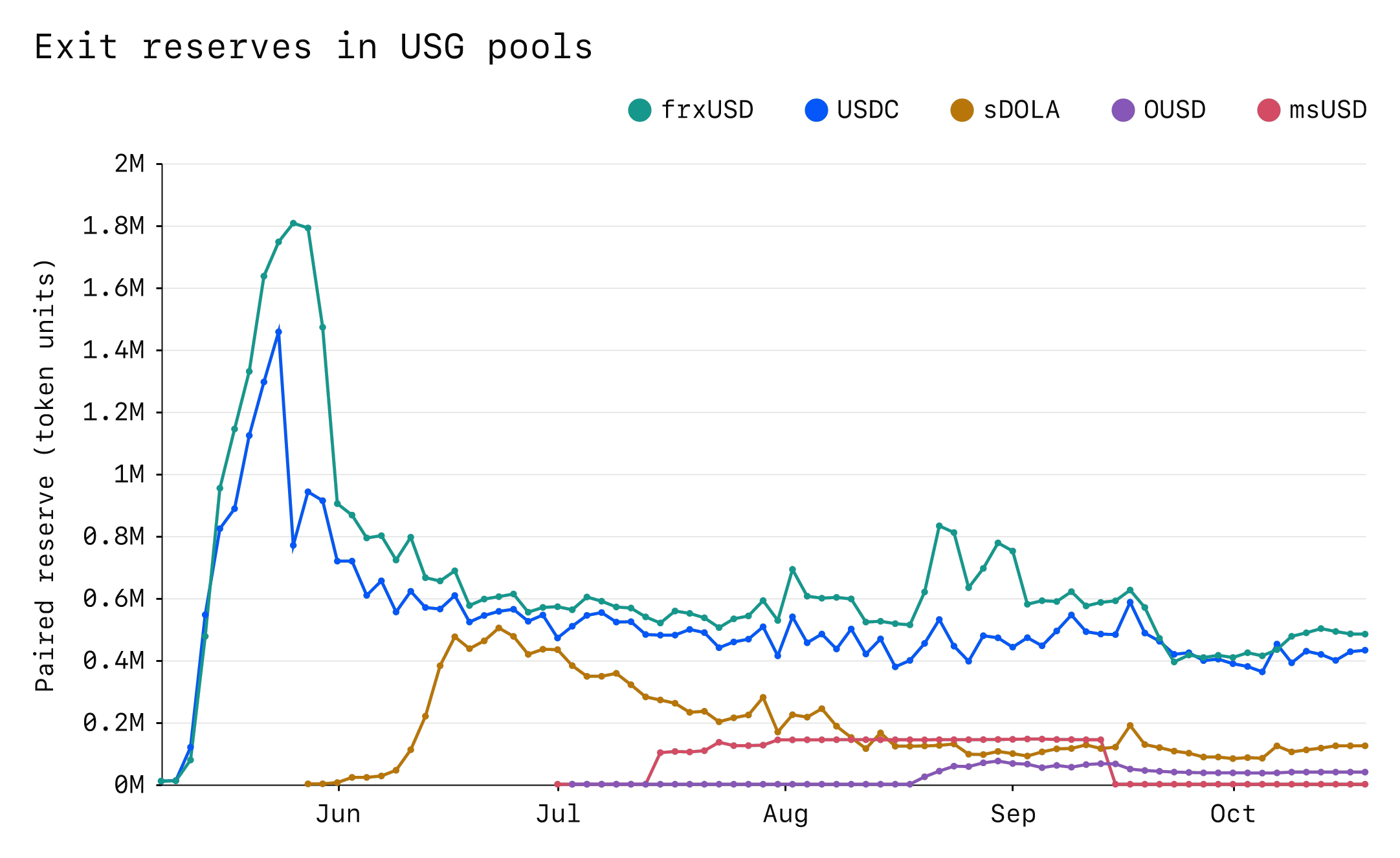
Figure 1. Exit reserves in USG’s Curve pools, 8 May–19 October 2026. Source: onchain pool balances at two-day intervals. sDOLA is converted to DOLA-equivalent using each date’s pool rate; other reserves are shown in native token units.24
USDC and frxUSD remain the largest exit reserves. Their sharp declines during May and early June 2026 reflected both USG sales and liquidity withdrawals, followed by more stable balances from July 2026. Other pools have varied more: sDOLA reserves peaked at about 500,000 DOLA-equivalent in June 2026 before falling to about 124,000, while msUSD reserves reached about 146,000 before dropping to almost zero in September 2026. The OUSD pool is smaller, holding about 39,000 OUSD.24
Peg support
Tangent sets borrowing rates from its USG price estimate, discussed under Valuation and oracle considerations. Rates rise steeply below $0.995 and reach their caps at $0.98:316
| USG price estimate | Standard markets (51% of debt) | Zero-interest markets (45% of debt) |
|---|---|---|
| $1.000 | 3.4–3.9% | 0% |
| $0.995 | 4.9–5.4% | 0% |
| $0.990 | 30% | 22–47% |
| $0.985 | 63–64% | 64–110% |
| $0.980 or lower | 110% | 110–161% |
The zero-interest markets pay Tangent from borrowers’ collateral rewards instead. Tangent’s share is 40% (50% for msETH) while the estimate is at or above $0.999, rising in steps to 90% (100%) at $0.995. Standard markets give up a fixed 2.5% of collateral rewards. The cbBTC/WBTC market (4.5% of debt) charges a fixed 6.3% regardless of USG’s price.316 Higher costs encourage borrowers to buy USG and repay their loans, supporting demand for the token.25
Two peg keepers support the USG/USDC and USG/frxUSD pools by adding or withdrawing USG. Each holds 20 million USG minted in advance for these operations, explaining why the token’s total supply of 43.82 million substantially exceeds its circulating supply of about 3.82 million outside the keepers. Both have previously deployed and withdrawn this inventory.242627 On 23 October 2026, the administrator burned 37 million USG from the keepers’ pre-minted inventory, reducing total supply to about 6.87 million, of which the keepers hold 3 million. This did not repay borrower debt.28
The keepers are contracts administered by Tangent’s 3-of-5 Safe, which also controls their regulator. Each can only add USG to, or withdraw it from, its own pool. The regulator’s check that a pool’s current price is close to its moving average, which in Curve’s code stops keepers acting on a briefly manipulated price, is set to a 100% tolerance and so does not apply. The keepers’ other safeguards remain, including a requirement that each action be profitable.2627
The peg keepers can add USG when it trades above peg, but their pre-minted inventory is not a cash reserve for buying it below peg. To push USG back towards peg, they must withdraw USG from pool positions they previously built. Both currently have zero recorded debt and no LP holdings to unwind.262729
USG has generally traded at a modest discount. Daily prices in its main USDC pool were within 0.5% of parity on 92% of dates from 7 May to 19 October 2026. On 3 October 2026, sales of about 387,000 USG by one wallet, followed by large liquidity withdrawals, pushed trading to around 0.977 USDC per USG. Purchases linked to borrower repayments helped the price recover to about 0.994 early the following day.29
Issuer and organization
Tangent describes itself as a DAO and evolved from Convergence, whose liquid-locker products now operate under the LiquidBoost brand.30 Administrative control currently rests with designated multisigs, discussed under Governance and control.14 The reviewed materials do not identify a legal entity responsible for issuing USG.
Wireshark, Convergence’s founder, remains a public-facing contributor to Tangent, having authored the proposal to transition from Convergence to Tangent and later submitted Tangent’s Curve grant application. This provides continuity between the two projects.31
Tangent maintains separate treasuries for protocol investments and liquidity, revenue distribution, and operating costs such as team expenses and audits.32 Its proposed governance token, TAN, includes allocations for creditors and users affected by the Convergence exploit.33 These resources are not identified as a dedicated fund for covering USG losses or redeeming holders’ tokens for dollars.3233 The treasuries hold about $1,500 in stablecoins and USG, plus other externally traded or withdrawable assets valued at about $29,000 before exit costs. Most remaining holdings are illiquid or depend on Tangent’s own tokens and markets.34
Governance and control
Administrative control
Tangent’s administrator is a 3-of-5 Safe, while its fee treasury is a 2-of-3 Safe. The fee treasury’s three signers also sign for the administrator and can meet its 3-of-5 threshold on their own, concentrating control over protocol settings and revenue distribution in three signers.14 Tangent says it uses Hypernative for multisig security monitoring and keeps signer private keys offline.35
The administrator can change collateral oracles, borrowing limits and liquidation thresholds without an enforced waiting period, so these changes can take effect as soon as the Safe approves and executes them.1314 Tangent plans Snapshot voting by locked TAN (vsTAN) holders. This voting system is not yet established in the reviewed deployment, and the multisigs retain administrative authority.1436
Powers over funds and withdrawals
Pausing does not need the administrator Safe. Tangent’s deployer EOA can pause and unpause new borrowing, leverage and collateral deposits in any market, and Tangent’s Hypernative monitoring account and the Safe can also pause them through a pauser contract.37 Pausing leaves repayments and collateral withdrawals open, but blocking collateral deposits can prevent borrowers from topping up loans to avoid liquidation.13
USG’s minting and burning permissions are also controlled by this Safe. It can authorise addresses to mint USG without adding collateral or burn USG from any account, including a holder’s wallet or the sUSG vault.620
The Safe can also stop repayments and liquidations in any market without delay. Revoking a market’s permission to burn USG makes its repayments, liquidations and bad-debt repayments fail.1320 It can also replace a market’s collateral oracle, raise the liquidation fee to 80%, raise the minimum loan size or set Tangent’s fee treasury to the zero address, which makes liquidations that charge a fee fail.1338
The administrator’s 3-of-5 Safe can also authorise a migrator to move borrower collateral and debt between markets, without an onchain timelock.1438 The source market checks that the migrator is authorised, but relies on it to recreate the loan and its backing at the destination. A faulty or malicious migrator could therefore remove collateral and clear the original debt while leaving the corresponding USG in circulation. The contract’s event history contains no migrator appointments through 19 October 2026.38
sUSG’s vault code cannot be replaced, but the 3-of-5 administrator Safe controls its operating permissions. The Yearn implementation allows it to add and fund strategies, although sUSG currently holds USG directly. It can also change how quickly profits unlock and impose withdrawal restrictions, even while the vault holds enough USG to pay holders.56
External collateral controls
Much of USG’s collateral is staked through Stake DAO, adding a separate layer of administrative control. Its controller and locker gateway are owned through a five-day timelock, while pre-approved contracts handle staking, rewards and migrations without a fresh delay for each operation. Emergency pauses can also take effect without that delay.8
f(x) Protocol’s 6-of-9 Safe controls the contracts holding collateral for Tangent’s two Convex f(x) positions, which back about 23% of USG debt. These contracts take LP tokens staked in f(x) gauges and deposit them into Convex. Gauge upgrades require a three-day delay, but the Safe can direct these contracts to move the underlying LP tokens without that wait. Misuse or compromise of its signing authority could therefore put this collateral at risk despite the upgrade delay.8
Valuation and oracle considerations
sUSG’s conversion rate can rise while its dollar value falls. The rate measures USG per share, so a discount in USG’s market price can outweigh the yield accruing in the vault, even when withdrawals continue normally.25
Each market has its own collateral oracle. For stable-pool LP tokens, Tangent multiplies the pool’s virtual price by the lower of its two underlying token prices, which accounts for pools accumulating the weaker token during a depeg. The CVX/ETH market instead uses the pool’s own LP price, which Curve quotes in ETH, converted to dollars with ETH’s price. Neither approach accounts for the price impact of selling a large position.39
Underlying token prices come from Chainlink or from Curve pools’ moving averages, which have a half-life of about ten minutes. Markets holding about 47% of USG debt price at least one token from their own collateral pool’s moving average. These averages smooth short-term fluctuations but can delay recognition of a depeg, and sales of liquidated collateral into those pools can lower the averages used to value the remaining loans.339
Tangent attempts to use a backup feed when a Chainlink price exceeds its age limit. USDC, PYUSD, USDT, ETH and cbBTC fall back to RedStone, whose adapter accepts prices up to 30 hours old; other backups use Curve moving averages. If backup pricing fails, liquidation and seizure can use a previously saved price, potentially an outdated one. If the primary feed call reverts, the backup is not reached and liquidation can be blocked.39
The collateral oracle contracts match the revision Pashov reviewed in December 2025.40 Tangent has accepted a later review finding that liquidation and seizure can rely on stale saved prices as intended behaviour.41
To adjust borrowing costs and reward deductions, Tangent estimates USG’s price from moving averages in its USDC and frxUSD pools, giving more weight to larger pools. It assumes USDC and frxUSD are each worth $1, so a shared discount in those assets could make USG appear closer to its peg than it is.42 The same estimate determines when peg keepers can add or withdraw USG.2742
Security and operational history
None of Tangent’s 18 current lending markets has recorded a forced liquidation or collateral seizure, so recovery from unhealthy loans remains untested in live operation.43 Tangent says it runs a liquidation bot even when gas costs make liquidation unprofitable.15
Tangent’s predecessor, Convergence, suffered an exploit in August 2024 that allowed an attacker to mint and sell CVG governance tokens intended for future staking rewards, collapsing CVG’s price. The community subsequently voted to pivot to Tangent. The exploit affected Convergence’s reward-distribution contract, rather than the Yearn vault implementation used by sUSG.30
Metronome disclosed a backing shortfall affecting msETH and msUSD on 30 July 2026. It reported closing the shortfall through buybacks in September 2026, but kept its synthetic swap module closed indefinitely.44 Tangent’s msETH/WETH market remains paused, with about 244,000 USG of debt against $600,000 of oracle-valued collateral and no registered bad debt. msETH still trades at about 0.884 ETH in its Curve pool, which Tangent’s oracle tracks, so the reported recovery has not restored its price.3
Audit history
| Date | Audit |
|---|---|
| 6 August 2025 | Egis Security |
| 28 August–11 September 2025 | Sherlock |
| 30 October–12 November 2025 | Pashov |
| 8–10 December 2025 | Pashov follow-up |
| 29 January 2026 | Zero Cool AI review |
The deployed code fixes the migration permission bypass identified by Sherlock (H-2); the administrator’s power to appoint a trusted migrator remains.4045 Sherlock also flagged that liquidation calculations assume USG is worth $1 (M-3), which Tangent acknowledged without changing the code.45 This is a common valuation methodology for CDP stablecoins. If USG trades above peg, liquidators must pay more to acquire the tokens needed to repay a loan, reducing their incentive to liquidate.
The deployed contracts include changes made after Pashov’s December 2025 review: small checks in lending logic, a fallback when the USG price feed used for interest rates fails, and reward-processing safeguards.40 Tangent made most of these changes to address findings from its later Zero Cool AI review. Zero Cool’s report notes that it did not review the fixes.41
Risk summary
sUSG holds USG directly, but its dollar value depends on Tangent’s loan backing, market liquidity and administrative controls.
- Stablecoin pegs underpin most of USG’s backing. High loan-to-value ratios rely on stablecoins and their yield-bearing wrappers retaining value. A depeg or impairment in a shared underlying asset can weaken several markets together.
- Collateral recovery depends on effective liquidation routes. No market has recorded a forced liquidation, and liquidators must buy USG to repay debt. Shortfalls can weaken USG’s backing, with no dedicated loss reserve specified.
- Immediate withdrawals do not guarantee a dollar exit. Redeeming sUSG returns USG, which holders must sell to receive USDC or another asset. Larger or simultaneous sales can incur substantial discounts unless new buyers or liquidity arrive.
- Administrators can weaken backing or block withdrawals and liquidations. Tangent’s 3-of-5 Safe can authorise minting USG without collateral or burning USG from holders’ accounts. It can also restrict sUSG withdrawals even when the vault holds enough USG to pay them, and disable repayments or liquidations in any market. These powers have no enforced execution delay.
Sources
-
Tangent Finance, Contract registry. ↩
-
Tangent Finance, Understanding USG. ↩ ↩2 ↩3
-
yRisk calculations from the 18 lending markets created through Tangent’s market creator, their collateral oracles and constituent pools. Collateral is valued at each market’s oracle price. ↩ ↩2 ↩3 ↩4 ↩5 ↩6 ↩7 ↩8 ↩9 ↩10
-
Tangent Finance, USG financial flows and sUSG savings account. ↩ ↩2 ↩3
-
Verified Yearn v3.0.4 vault implementation, used by sUSG’s fixed minimal proxy. ↩ ↩2 ↩3 ↩4 ↩5 ↩6 ↩7 ↩8
-
yRisk onchain measurements of sUSG balances, supply, roles and settings, including its USG holdings. ↩ ↩2 ↩3 ↩4
-
yRisk balance measurements and fee-inclusive sale quotes from the USG/USDC pool. ↩
-
Verified Stake DAO receipt implementation, protocol timelock and f(x) liquidity-manager implementation; yRisk analysis of custody, owners, modules, delays and reward transfers, including the f(x) Safe’s administrator role over the FXN token and veFXN. ↩ ↩2 ↩3
-
yRisk onchain measurements of Resupply’s registry and insurance pool; Resupply, Collateralized debt positions and Insurance pool; f(x) Protocol, Risk framework and Peg mechanisms. ↩
-
Liquity, Borrowing and liquidations and Redemptions; Curve, LLAMMA mechanism. ↩
-
yRisk census of all 73 borrower positions in the 18 markets created through Tangent’s market creator, including accrued interest. ↩ ↩2
-
Verified market implementation sources for Stake DAO vault markets, Convex f(x) markets and Curve gauge markets: liquidation, seizure, bad-debt repayment and administrator settings. ↩ ↩2 ↩3 ↩4 ↩5 ↩6 ↩7 ↩8 ↩9 ↩10
-
yRisk analysis of Safe signers, thresholds and modules for the administrator and fee treasury. ↩ ↩2 ↩3 ↩4 ↩5 ↩6 ↩7
-
Tangent Finance, Health and liquidations. ↩ ↩2
-
Verified interest calculator and reward accumulator. ↩ ↩2 ↩3 ↩4
-
Wireshark, private team message supplied 29 October 2026; Tangent, FeeDispatcher source. ↩
-
yRisk reconciliation of USG transfers from the fee treasury to sUSG with the vault’s income reports, 25 May–19 October 2026, for example the 15 October 2026 distribution transaction. ↩
-
yRisk calculations from sUSG conversion rates, 28 July–19 October 2026. The annual figure compounds the observed USG-per-share growth over a 365-day year. ↩
-
Verified USG token source. ↩ ↩2 ↩3
-
yRisk comparison of USDC quotes through LlamaSwap, 26 October 2026; route details from the KyberSwap aggregator API. ↩ ↩2 ↩3
-
yRisk comparison of assets in the sUSG/reUSD pool. Token contracts: Re Protocol Deposit Token, Resupply reUSD. ↩
-
yRisk analysis of LP-token and gauge holdings in the USDC and frxUSD pools, and of incentive-campaign funding. ↩
-
yRisk analysis of onchain balances in USG’s USDC, frxUSD, sDOLA, OUSD and msUSD Curve pools at two-day intervals, 8 May–19 October 2026, with transaction-level analysis of USDC and frxUSD pool sales and withdrawals. ↩ ↩2 ↩3
-
Tangent Finance, Peg stability and Peg keepers. ↩
-
yRisk measurements of USG supply and of the USDC and frxUSD peg keepers’ balances, debt and LP holdings, with their regulator’s allowances and settings. ↩ ↩2 ↩3
-
Burn transaction, 23 October 2026; yRisk measurement of USG supply and the keepers’ balances afterwards. ↩
-
yRisk analysis of daily USG/USDC pool prices, 7 May–19 October 2026, and of sales, liquidity withdrawals and borrower repayments during 3–4 October 2026. Daily percentages describe sampled prices, not continuous intraday prices. ↩ ↩2
-
Wireshark, Vote for Convergence’s future, August 2024; Tangent Finance grant application, March 2026. ↩
-
Tangent Finance, DAO wallets. ↩ ↩2
-
Tangent Finance, TAN tokenomics. ↩ ↩2
-
yRisk measurements of Tangent’s treasury assets and loans, valued using DefiLlama prices, Curve pool data and Tangent’s collateral oracles. ↩
-
Tangent Finance, private team responses received 20 October 2026. ↩
-
Tangent Finance, Governance. ↩
-
Verified Control Tower pauser settings and pauser contract; yRisk analysis of pause permissions and events, and of contract-creation records showing that the pausing account deployed USG and the Control Tower. ↩
-
Verified Control Tower, including its fee-treasury setting, and market migration paths; yRisk analysis of migrator permissions and appointment history. ↩ ↩2 ↩3
-
Verified stable LP oracle, Chainlink wrapper, Curve constituent feed and RedStone adapter. ↩ ↩2 ↩3
-
yRisk comparison of deployed verified source with Pashov’s fixed revision b79c0f1. ↩ ↩2 ↩3
-
Zero Cool, AI review of Tangent, which states that no fix review was performed; Tangent, review tracker. ↩ ↩2
-
Verified USG price aggregator; yRisk analysis of pool inputs and settings. ↩ ↩2
-
yRisk review of liquidation, collateral-seizure and voluntary self-liquidation events in the 18 markets created through Tangent’s market creator, from deployment to 19 October 2026. ↩
-
MetronomeDAO, Underbacking post-mortem, 30 July 2026, and Recovery update, 16 September 2026. ↩
-
Sherlock, Tangent contest report, 11 September 2025, H-2 and M-3. ↩ ↩2